

THE REEL culture series / no. 1 the godfather: a family affair–
No. 1
The Godfather: A Family Affair
P & R’s “The Reel” series begins with highlights of film’s role in the exploration of culture and identity. Simply said, both food and film are tied to powerful influences of how we say who we are. For more on this concept, see The Plate & The Reel’s “About” page.
Can we safely say that in the beginning was the image, not the word? We saw before we named. We observed and then created drawings and pictorial symbols on rock walls to communicate ideas about real life environments. Humans have always created a visual medium with which to communicate. Since its entrance into American society as an industry in 1910, cinema has taken center stage as a powerful form of communication, shaping and influencing our impressions of the world. Despite its hybrid nature made up of literary art, aesthetics, sound, cinematography, artistic screen composition and performing arts, the silver screen is truly a medium where a picture is worth a thousand words.
When The Godfather became a subject for cinema in 1971 it coincided with the 1970s cultural movement encouraging us to find our roots. This resurgence of “roots advocacy” became synonymous with the search for origins and “authentic” cultural identity. In short, with this film, it became cool to be “ethnic” (not an embarrassment). Despite The Godfather’s stereotypical topic of “Italian crime” driving its narrative, this film became a phenomenal reinvention of how screens represented Italian-Americans. For many viewers, The Godfather’s presentation of this new ethnic dimension, parallel to the popularization of authentic roots, felt empowering. The film’s version of old-world Italian traditions of song, dance, food, family photographs, New York neighborhoods, street life and highlights of ethnic identity was a marketable commodity. See free Chapter XI download– “The Godfathers as America,” in Camera and Action.
The Godfather— the Wedding Scenes—
The movie sets up the central visuals of Italian tradition with Connie Corleone’s wedding. The scenes are loud, happy, bright and joyful with plenty of food, wine, song and dancing. Viewers see homemade red wine being served with peaches (vino e percoche)—which you can actually order at Valter’s Osteria in SLC).
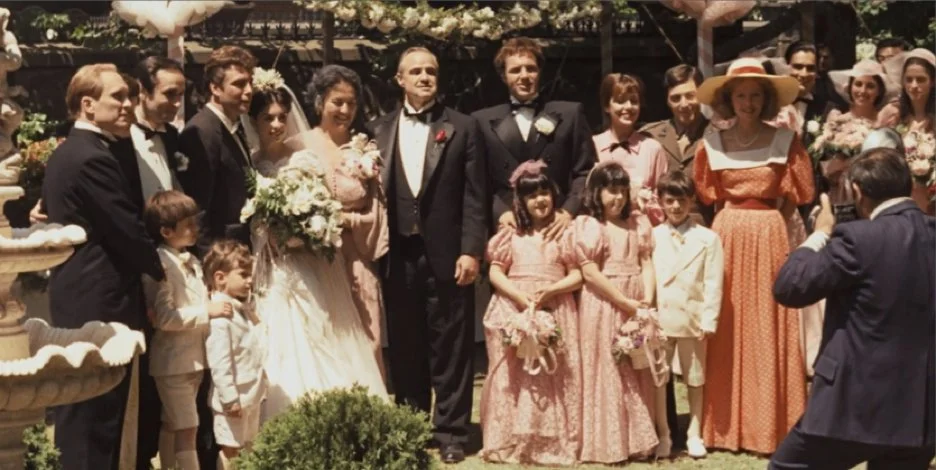
The wedding sequence also captures the key component of Italian tradition by centralizing the importance of the family to Italian identity. The family photograph takes us through three generations of Corleone’s —immigrant to grandchildren. The scene very cleverly pulls in one non-Italian guest—Michael Corleone’s girl friend Kay Adams played by Diane Keaton—to introduce the mainstream, modern and independent American woman in contrast to the traditional ethnic woman.
Next up is the father/daughter wedding dance, sequenced with switches back and forth from them dancing to the guests joining in the traditional Italian folk dance and singing traditional folk songs in Italian and then in English—Frank Sinatra style. And there you have Italian “authenticity” on the screen for the first time in American film history.
Now for the food.
Tables and tables are filled with plates of homemade food and glass decanters of handmade wine, loaves of Italian bread, traditional Italian cookies, and bowls of oranges. The film is filled with 30 plus scenes of Italian foods/drinks. The images of food emphasize the cultural significance of Italian hospitality and generosity—a definite marker of ethnic communities. Food also functions to reinforce the “mainstream” contrast to ethnicity when Michael asks Kay, “You like your lasagna?”
Other food scenes include conversations taking place about ingredients and recipes. Food scenes occur at Louie’s Italian-American restaurant in the Bronx where Italian wine is poured, an Italian veal dish is served, and Italian is spoken just before two assassinations occur (some kind of hospitality that is!). The film’s most famous line, “Leave the Gun. Take the Cannoli” uses a popular Italian dessert to show the importance of food to an American Italian who wouldn’t dare go home without it. And oranges come into play again when the attempted assassination of Don Corleone takes place while he is buying oranges at the market.
So there you have it—film’s use of food and family scenes actively constructing cultural identity on screen. Food’s role in creating and transmitting cultural identity in this film cannot be underestimated. The Godfather was timely. It did its job to endorse on screen a sense of ethnic “belonging” (not a dilemma) in the larger American society.
Where ethnicity, tradition, and custom define the Corleone family within a larger society in The Godfather, The Godfather Part II, leaves ethnic ties behind and becomes a narrative of cold, hard crime.
Not many plated meal scenes needed in Part II.
"A man who doesn't spend time with his family can never be a real man." — Don Vito Corleone from The Godfather